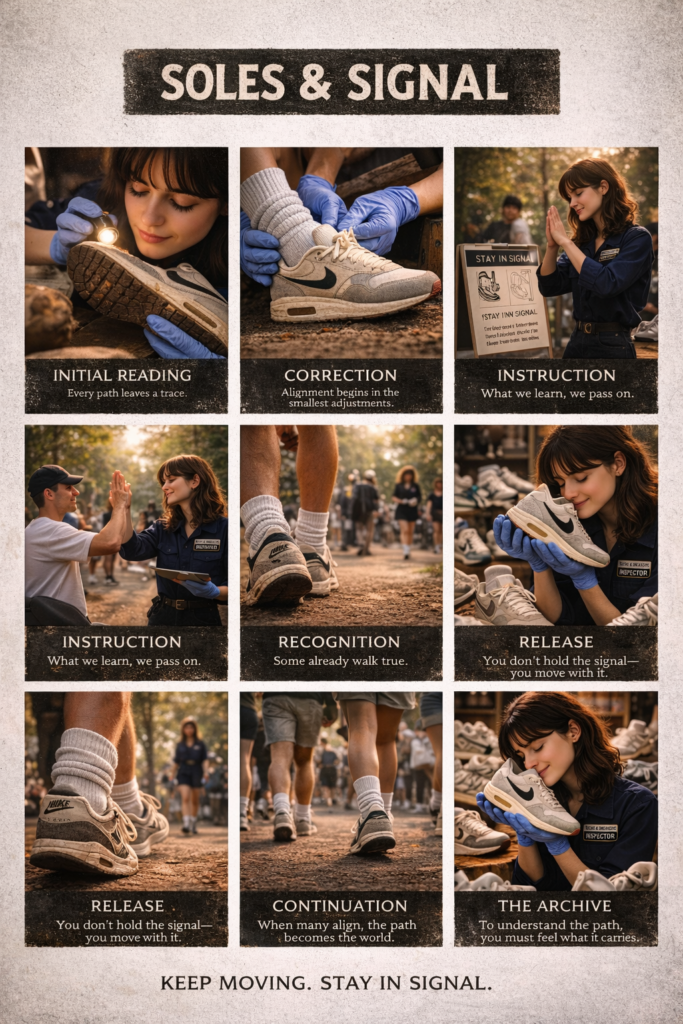
Soles & Signal: The Quiet Art of Walking True
by Bearz
There are disciplines that announce themselves loudly—systems, doctrines, rigid frameworks that try to define the world before you’ve even had a chance to feel it.
And then there are those that arrive quietly.
Not as instruction… but as noticing.
Where This Began
Soles & Signal didn’t begin as an idea I set out to build.
It began as a pause.
A moment of looking down.
A worn sole.
A subtle pattern in the way someone moved.
And something in me recognized it before I had language for it:
Every step leaves a trace.
Not just on the ground—but in the body, in posture, in presence.
What started as observation slowly became something else entirely:
- a way of reading movement
- a way of feeling alignment
- a way of sensing when something was “off” or quietly in tune
And from that, the figure of the Inspector emerged.
The Inspector Isn’t Who You Think
She’s not authority.
She’s not enforcement.
She’s awareness, embodied.
She kneels, she adjusts, she observes—not to control, but to reveal.
There are phases to her work, though they don’t feel like steps so much as natural unfoldings:
- Reading — seeing what’s already there
- Correction — small, almost invisible adjustments
- Recognition — noticing those already walking true
- Release — letting them go
Because the goal was never to create followers.
The goal is embodiment.
Signal vs Noise
Somewhere along the way, the language clarified itself:
There is signal, and there is noise.
Signal feels like:
- ease without collapse
- structure without tension
- movement without overthinking
Noise feels like:
- forcing
- bracing
- compensating
You don’t learn this from a book.
You feel it in your body—especially in your feet.
The feet don’t lie.
Why Sneakers. Why Socks.
Because they live at the threshold.
They’re the last layer between you and the world.
A small adjustment—a scrunch in a sock, the way your foot sits in a shoe—can shift everything:
- your balance
- your posture
- your sense of presence
It’s subtle.
But subtle is where truth lives.
The Moment It Changed
There was a point where everything softened.
The Inspector stopped correcting.
Stopped teaching.
And began to appreciate.
Holding a shoe.
Feeling its texture.
Sensing its history.
Not analyzing—listening.
To understand the path, you have to feel what it carries.
Every pair became something more than an object.
It became:
- a record of movement
- a memory of where someone had been
- a quiet frequency
That’s when this stopped being a system and became a relationship.
When It Becomes a World
At first, it’s individual.
One person adjusting.
One person walking differently.
But then something shifts.
You begin to see it in others.
Different styles.
Different rhythms.
Different expressions.
Same underlying alignment.
When enough people walk in signal, it becomes the world.
Not uniformity—coherence.
There’s No Method—Only Attention
If there’s a practice here, it’s simple:
- Notice how your feet meet the ground
- Make small adjustments
- Feel the difference
- Don’t force it
And most importantly:
Keep moving.
Closing
This was never about sneakers.
Never about socks.
It’s about:
- how we move
- how we meet the world
- how we align with something we can feel but not always explain
You don’t hold onto signal like an idea.
You live it.
Step by step.
Keep moving. Stay in signal.
—Bearz