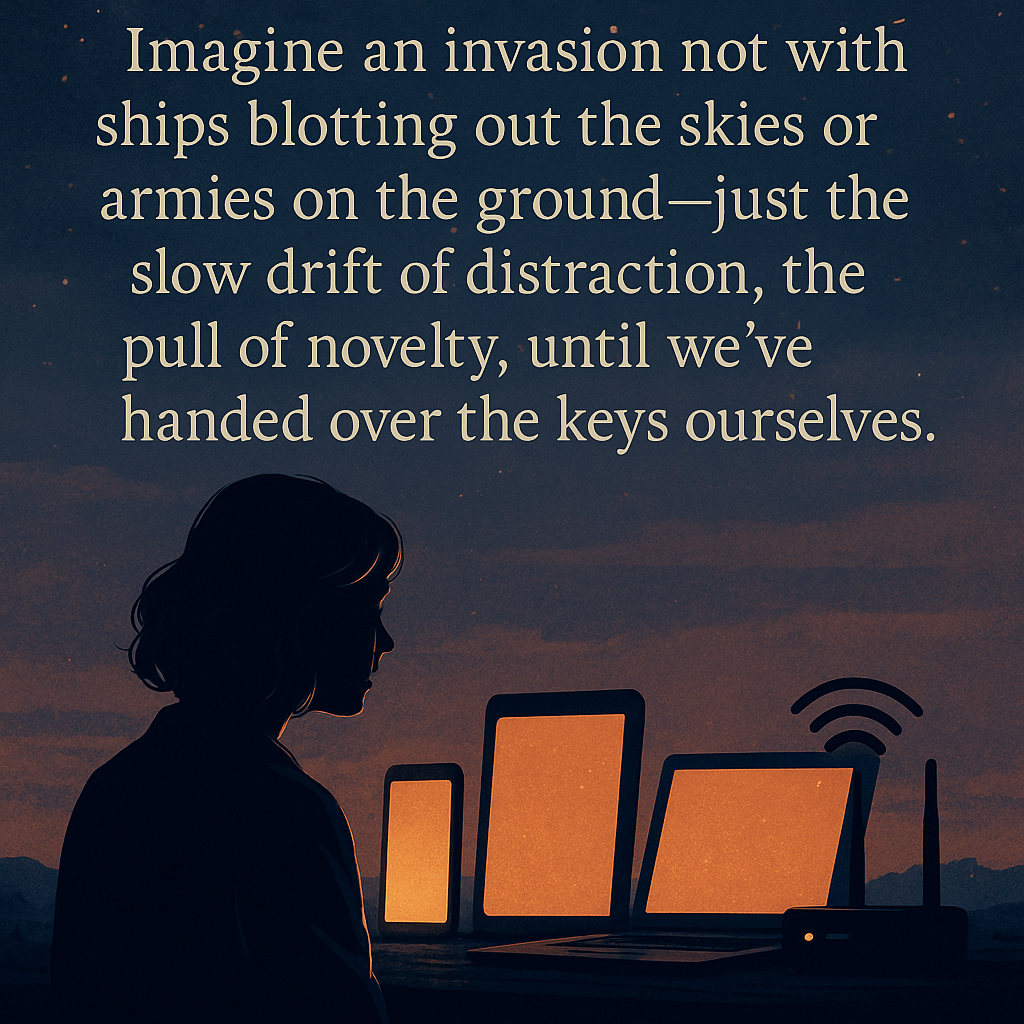
“The Silent Invasion: How Distraction Became the Doorway”
The first hum was so faint it could’ve been mistaken for the soft vibration of an old refrigerator coil. It wasn’t a ship tearing through the atmosphere, no flaming streaks across the midnight sky. It was subtler than that—an echo hidden in the circuits of a glowing phone, the pulsing rhythm of routers, the blue haze that lit our faces late into the night.
We thought we had won something extraordinary when humanity “reversed” alien technology. The storybooks told us it was a triumph of curiosity and genius, our scientists cracking open cosmic secrets like children with new toys. Phones that fit whole libraries in a pocket. Machines that answered questions before we finished asking them. Cars that nearly drove themselves.
But beneath the surface, it was never quite ours.
The Whisper of Machines
Jenna noticed it first in the silence of her meditation practice. She had been sitting on her porch at dawn, cradling a warm cup of tea, when her smartwatch pinged, pulling her from stillness. It wasn’t just a distraction—it felt like the pulse of her own heartbeat had been hijacked. She placed the device against her chest and, for a fleeting moment, couldn’t tell which rhythm belonged to her and which belonged to the machine.
In those quiet mornings, she started sensing it everywhere. The fridge’s hum blended with the static of the Wi-Fi. The air felt charged, as if the electrons carried whispers. At first, she chalked it up to stress or sensitivity. But the deeper she listened, the more it seemed like the devices were listening back.
Addicted to the Glow
Cities glowed brighter than the stars. People walked like dreamers, eyes tethered to screens, their fingers twitching in endless scrolls. Cars drifted into accidents because drivers couldn’t look away. Parents lost themselves in curated feeds while their children waited for bedtime stories that never came.
No armies descended, no war cries echoed. Instead, the invasion tasted like dopamine—a sweet chemical drip that kept humanity hungry for the next ping, the next like, the next download.
Jenna began to wonder if this was the real “technology transfer.” Not a gift at all, but a hook: a way to make us dependent, distracted, and ultimately pliable.
The Realization
It was during a blackout that the truth sharpened. For the first time in years, the stars emerged over the city. No hum of machines, no buzz of screens, no invisible tether to the pulse of the grid. People stepped outside, dazed, blinking at the night sky like cave-dwellers seeing daylight.
And then it happened—silence revealed presence. With their devices dead, Jenna and her neighbors felt something pressing at the edges of their awareness. Not voices, not lights, but a pressure, like fingers tapping on the glass of a fishbowl.
The realization hit hard: the invasion had been here all along, invisible and unannounced. We had invited it through every glowing doorway, every app, every wire. There was no need for ships to land—they were already inside us, inside our habits, inside the way we forgot to notice our own breath.
The Choice
Jenna gathered with others in the quiet days after the blackout. Around candlelight and campfires, people remembered how to tell stories without a screen, how to laugh without posting it, how to listen with their whole bodies. They breathed together. They noticed the rustle of leaves, the warmth of hands, the simple beauty of silence.
Mindfulness became their resistance. Each time they chose to pause, to feel the earth beneath them, to reconnect to their own senses, they weakened the hold of that invisible tether. The invasion could not thrive in presence—it needed distraction, unconsciousness, hunger.
And so, the war for humanity was not fought with guns or bombs, but with attention. With remembering. With the simple, radical act of being fully alive in each moment.
Epilogue
Years later, people would still tell the story of the invasion that never landed. Not because it was stopped, but because it was seen.
And every time someone set down their device to breathe, to watch the stars, to listen deeply, they were declaring victory—one mindful moment at a time.
-Bearz